Posts

Showing posts with the label Birds

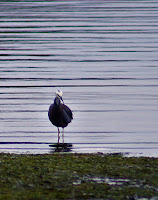
Andrew: White-Faced Heron
Image
Hello. this bird info post is about the White-Faced Heron. This bird is known by many different names such as the blue crane, or the blue heron. This bird is the most common Heron in New Zealand and the numbers are incredible on Stewart Island (they`re just very good at hide and seek). They are a medium sized heron and have blue-grey plumage. They, as the name suggests, have a white face and a small portion of the neck is white as well. They appear in Australia, New Guinea and, of course, New Zealand. This is one of the most common large birds in New Zealand. They usually breed at the top of trees where they lay and incubate 3-5 eggs. Egg laying usually peaks at the end of October. The egg incubation takes up to 27 days. They eat a wide range of food such as frogs, tadpoles, fish, crabs, insects, etc and they can adapt well to almost any environment. This species does very well because their eggs can`t be eaten by rats or stoats (but the rats and stoats do not want to mess with a l...

Andrew:Takahe

Image
Hello, this post is about a special bird called the Takahe. This bird is endangered and has under 150 left in the world. I saw this bird at the Te Anau bird sanctuary where we decided to take some photos. This large flightless bird is a member of the rail family of birds and is about the size of a very large hen. They are the largest member of the rail family. This bird likes to eat the leaf base and other parts of the tussock or other grasses, yet they do eat invertebrates, mainly during the chick rearing session. This bird has the most of its numbers at the Fiordland, Te Anau bird sanctuary. Strangely this flightless bird has wings for showing off to its mate. It was thought to be extinct from 1898 to 1948 until it was rediscovered with barely any population. For the last 70 years we have made various conservation efforts and most are working. Slowly but surely their numbers are growing. Here are some pictures I took of this rare and endangered bird.   I hope you enjoyed th...

Andrew:Weka Bird

Image
Hello, here is another bird info post. Today, I am writing about the New Zealand Weka. This bird is a flightless and large bird. They don`t seem to mind human activity and love pecking around your backpack looking for food. They are however very annoying to farmers who hate seeing their precious food being trampled and stolen in front of their very own eyes. However, I think they are very cute. They are a member of the Rail family of birds. The ones from Stewart Island are usually very strong chestnut brown but they still act the same funny, peckish way. They are usually around the south side of New Zealand, and are rare in the north island. They eat whatever they can get their hands on (or feet on, for that matter) and don`t mind it, though their natural diet is made up of fruit, invertebrates and some small animals. But they have been known to kill and eat stoats and west land petrels. We saw this one at Ulva Island bird sanctuary where they swam at the beach with us (and also ...

Lachlan:The search for Kiwis

Image
Hello! Today I am talking about my trip to the reserve to look for Kiwis. Even though we didn't find any we did hear them in the woods running around. Just in case you are confused that it was most likely they were flying around  they actually can't fly. They may have wings but they are under it's feathers. So it started off by us going to an observation rock. Mum and I left early to go to the reserve to look for some places where we might find some Kiwis. After we did that we waited until dark because they are nocturnal and then we looked for some Kiwis. The first things we saw were some deer walking around. We walked over to a swing mum and I saw when we walked around earlier. I really liked swinging on it because it swung over a really spiky plant. After that we started looking in the bushes. We found a few deer but no Kiwis but we could still hear them running around.

Andrew: Birds we`ve seen

Image
White Faced Heron Kaka Tui New Zealand Pigeon Weka Takahe

Andrew:New Zealand Pigeon

Image
This bird is special as they breed anytime of the year. The female lays one smooth white oval egg. If this egg is lost the female may lay another egg in the same nest. It takes 10 to 11 weeks for the young pigeon to leave the nest. The incubation period of the egg is 29 to 30 days and is carefully watched over by both of the parents. Usually these birds devote a quarter of their daylight hours to eating. As these are purely herbivorous this is very surprising because the plants they eat do not provide much energy. We saw this bird in a tree near to our house so dad and I decided to take a few photos. A feeding or roosting bird will usually fly from its perch circles around and either goes to its original position or it goes to a taller tree. They are usually silent but it is described as a soft oooo when feeding or resting. Both genders look the same. I also have to say that it is very big for a pigeon. Take our Australian crested pigeons times that by three and that is r...

Andrew:Tui

Image
    A relative of the bell bird, this songbird can be very noisy. Unlike the bell bird though, these birds have a much greater variability in their voice. it is usually the first bird to sing in the morning. They moult after breeding during the summer. They are very common in native forests but they avoid pure beech forest. It also lives in suburban gardens as long as their native forest is near. They have a very colourful breast and will fly considerable distance for a concentrated food source. Their main diet is nectar, but fruit and insects are also common. Fun fact: It can perfectly mimic a bell bird`s song and some can mimic other birds. Fun fact 2: their scientific name is prosthemadera novaeseelandiae  We are staying in Oban. We saw it while we were walking back with chips when mum heard this very noisy bird only two houses away from our house. I took this photo of it. (top) We saw it in a tree nearby as well but it was hard to see as the sun was...

Andrew:Kaka bird

Image
This New Zealand bird is a very large bird. The male is sometimes brighter and their bill longer. Other than that the two genders look alike.   We saw the south island Kaka. It is very similar to the north island  Kaka, but the south is larger with more vividly coloured green and red plumage. Their call is a loud grating sound and loud quavering whistle on a descending note. It has sharp claws. It is in a forest area and appears at the balcony of our house. It lives in the rain forest near our house. It appears friendly and it seems to like food (AKA soggy bread). It did not appear to be scared, it just comes and goes. These are real pictures (see it eating the soggy bread) and they were all up close. All these pictures and the bird are from stewart island/ rakiura